
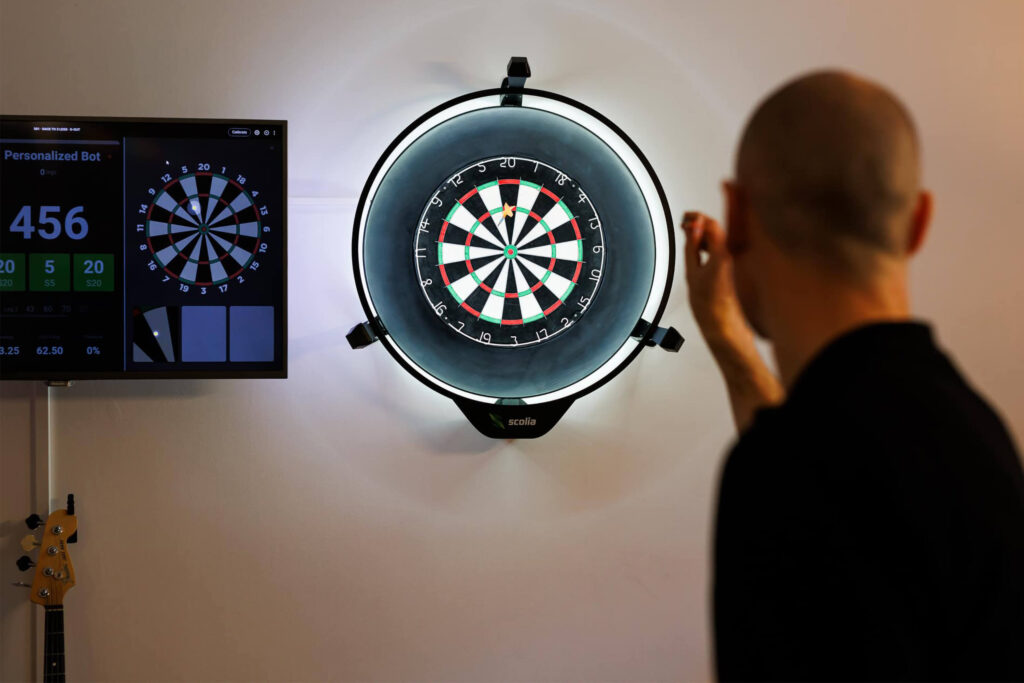
A typical consumer electronic dartboard and a steel-tip autoscoring system both update scores automatically, but they do it in different ways. An electronic board is itself the scoring device: soft-tip darts hit sensor-backed plastic segments. Steel-tip autoscoring keeps a traditional bristle dartboard and normal steel-tip darts, while cameras around the board detect where each dart lands.
The choice is therefore not simply manual versus automatic. It is also about which darts, board feel and playing environment are important to you.
What is an electronic dartboard?
An electronic dartboard usually has moulded plastic scoring segments with small holes. Players use soft-tip darts and sensors inside the board register which segment was hit. The score then appears on the board, a connected display or an app.
This makes electronic darts an easy all-in-one route to automatic scoring. Many boards include built-in games, sounds and visual effects. App-connected models may also add player profiles, statistics or online matches. The exact features depend on the board and its software.
The important point is that the electronic board replaces the traditional bristle board. You are not adding scoring technology to the your steel-tip setup; you are choosing a different board and dart format.
That is not a disadvantage by itself. Soft-tip electronic dartboards can be a good fit for players who enjoy the soft-tip game, want automatic scoring in one device or prefer the games and social features of a particular electronic darts platform.
What is a traditional steel-tip dartboard?
A traditional steel-tip setup uses steel-tip darts and a bristle dartboard, usually made from tightly packed sisal fibres. The dart point enters the board, while metal wire separates the scoring areas.
The board has no scoring electronics of its own. If you use it on its own, somebody must count and record the score. A paper scoreboard, digital counter or darts scoring app can help with the maths, but the result still needs to be entered manually.
Many players choose this format because it preserves the familiar steel-tip throwing experience seen in traditional and professional darts. A standard bristle board also makes local play straightforward, since you can start a game without power, device pairing or software.
The extra work comes between visits, when someone still has to calculate and record each score. If that starts to interrupt practice or matches, digital scoring tools can keep the game moving while allowing you to continue using the same dartboard.
How does camera-based steel-tip autoscoring work?
Camera-based steel-tip autoscoring is an upgrade around a normal bristle dartboard. Fixed cameras view the playing surface, and software calculates the position and score of each dart. The score updates without the player entering every visit by hand.
This creates a smart dartboard experience while keeping steel-tip darts and the familiar bristle board. Depending on the system, the software may also offer game history, throw statistics, heatmaps, training games, online opponents or tournaments.
Unlike a soft-tip electronic board, the bristle board is not sensing the hit. The cameras and software are doing the scoring. That difference matters when planning a setup: camera-based systems need a clear view of the board and may have specific requirements for lighting, mounting, space, power and connectivity.
They also cost more than using a normal board with a basic scoring app. The value is in reducing manual input while preserving the steel-tip format.
What about app-connected dartboards?
“App-connected dartboard” can describe two quite different setups.
The first is an electronic soft-tip board that sends detected scores to a phone or tablet. In that case, the board senses the hit and the app supplies the game interface, records or online features.
The second is a normal steel-tip board used beside a darts scoring app. Unless cameras or other detection hardware are also present, the app does not know where a dart landed. You still type in the score after each visit.
This is why terms such as smart dartboard, automatic dartboard and app dartboard can be confusing. Before buying, check three things: which darts the system uses, whether the board itself is being replaced and whether scores are detected automatically or entered by the player.
Electronic dartboard vs steel-tip autoscoring: quick comparison
| Feature | Electronic soft-tip dartboard | Steel-tip camera autoscoring |
|---|---|---|
| Darts and board | Plastic soft-tip darts; perforated sensor board | Steel-tip darts; compatible bristle board |
| Where detection happens | Sensors inside the board register the hit | Cameras and software calculate the dart position |
| Manual score entry | Usually none during normal play; occasional corrections may still be needed | Usually none during normal play; occasional corrections may still be needed |
| Playing feel | Electronic soft-tip format | Traditional steel-tip format |
| Digital features | Built-in or app-based; vary by model | App- or browser-based; vary by system |
| Setup | Electronic board, power and any app or display connection | Board, camera hardware, processing or display device, power and suitable mounting space |
Features vary by model and platform, especially for statistics, online play and subscriptions. Check the current product specifications rather than assuming every connected board offers the same tools.
Which setup should you choose?
Choose a soft-tip electronic dartboard if you actively want to play electronic darts. It makes sense when automatic scoring, built-in effects and a particular soft-tip app or online community matter more than keeping a bristle board.
Choose a traditional bristle board if you want the simplest steel-tip setup and are comfortable scoring manually. Add a scoring app if you want help with calculation, game management or basic records at low cost.
Choose camera-based steel-tip autoscoring if the steel-tip board feel is important but manual scoring is getting in the way. It is the clearest route when your priorities include hands-free scorekeeping, measurable practice or smoother online steel-tip matches.
If you are unsure, start with the experience you do not want to compromise. Do you want soft-tip darts and an electronic-board ecosystem, or do you want to keep normal steel-tip darts? That answer usually narrows the decision quickly.
What should you check before buying?
- Which darts and board type will you use?
- Is scoring detected automatically, or does an app still need manual entry?
- Which game modes, statistics and online features are available now?
- What mounting, lighting, power, space and connection requirements apply?
- Can scores be corrected easily when a hit is not registered as expected?
- Are subscriptions or platform-specific accounts required?
Gdzie sprawdza się Scolia
Scolia is the world’s No. 1 camera-based automatic scorekeeping system for steel-tip darts. It works around a compatible standard-size steel-tip dartboard rather than replacing it with a soft-tip electronic board. Its software supports local and online games, training formats, statistics and heatmaps. The system’s exact compatibility and setup requirements depend on the Scolia model and installation.
Scolia therefore fits players who already know they want to keep their traditional bristle board and steel-tip darts, but want the scoring experience to become automatic.
Compare Scolia autoscoring systems to see the current models and setup differences.
The difference in one sentence
An electronic dartboard gives you automatic scoring by changing to a sensor-based soft-tip board, while camera-based steel-tip autoscoring gives you automatic scoring while keeping a traditional bristle board and steel-tip darts.
Neither is automatically better for every player. The right choice is the one that matches the darts experience you actually want at home.