
Automatic darts scoring detects where steel-tip darts land on a compatible bristle dartboard and updates the score without manual entry. Fixed cameras watch the board, software calculates each dart’s position, and the game screen records the result. You keep your steel-tip darts and a normal dartboard; the system adds automatic scorekeeping around them. Unlike an electronic dartboard, it does not rely on sensor-backed soft-tip segments.
Why players look for automatic scoring
Manual darts scoring can interrupt a close 501 leg. After each visit, you stop to count, record the score or enter it into a phone, and correct any mistake. That may be manageable in occasional games, but over a long practice session or online match it breaks concentration. Automatic scorekeeping keeps the game moving.
How camera-based automatic dart scoring works
Most camera-based automatic dart scoring systems follow the same basic process:
- One or more cameras keep a clear, fixed view of the dartboard.
- The system is calibrated to the board, either automatically or during setup.
- When a dart lands, image-processing software identifies its position.
- The scoring software matches that position to the correct segment, updates the game and can save the throw for later analysis.
After each visit, you remove the darts and continue. The score may appear in an app or browser, be announced aloud and feed into statistics. Camera systems can occasionally misread a tightly grouped visit or blocked view, so an easy correction process matters.
What makes automatic darts scoring stand out?
The practical difference is how much scoring work the system takes over. A darts scoring app still asks you to enter each visit, an electronic dartboard detects soft-tip darts with built-in sensors, and webcam darts usually use video for visibility rather than detection. Dedicated steel-tip autoscoring combines a compatible bristle board with fixed cameras, automatic score entry and throw data.
The score is captured at the board
With a darts scoring app, you enter and check each visit. Autoscoring detects the dart position and sends the score to the game. Apart from occasional corrections, the routine is simply throw, retrieve your darts and continue.
You keep the steel-tip playing experience
Electronic dartboards use soft-tip darts and sensors built into the board. Camera-based steel-tip autoscoring adds cameras and software around a compatible bristle board, giving players automatic scorekeeping without changing dart format.
The cameras turn each throw into game data
Webcam darts can show the board to an opponent but often still require manual entry. Autoscoring cameras calculate the result, allowing compatible software to use each throw for scoring, statistics and online play.
Autoscoring systems can take your darts games online
The most advanced camera-based autoscoring platforms can also connect you with players beyond your own darts room. You can play online with friends, face opponents from around the world and take part in online tournaments, with scores flowing into the match as you play.
A fixed setup gives you a repeatable routine
Phone-camera darts apps are easy to try, but detection depends on phone position, lighting and a stable view. A dedicated system uses fixed, calibrated cameras, trading higher cost and installation for a repeatable hands-free routine.
For occasional games, a darts counter or scoring app may be enough. Autoscoring suits players who want steel-tip darts, hands-free detection and automatic game data.
What does automatic scorekeeping help with?
The clearest benefit is rhythm. You throw, the score updates, and you move into the next visit with less tapping, counting and checking.
Automatic throw data can record averages, checkout statistics, segment analysis and heatmaps, depending on the software. This makes progress easier to measure across many visits without logging every throw by hand.
Autoscoring does not replace darts maths. You can still practise checkout routes and finishes while the system records each score.
Does it still feel like steel-tip darts?
Yes. Steel-tip autoscoring adds cameras, a processing unit and a game screen around a compatible bristle dartboard. You still throw normal steel-tip darts and play familiar games such as 501 or Cricket. Compatibility varies, so confirm that the system supports your board and available space.
What should you check before choosing a system?
A darts scoring app may be enough if you only want help with the maths. Autoscoring becomes more relevant when manual entry interrupts practice, you want detailed throw data or you regularly play online.
Then check the practical requirements:
- Which dartboards, number rings and darts are supported?
- How much clear wall or room space is required?
- Do the cameras need fixed mounting or a particular light surround?
- Is calibration automatic, and how easy is score correction?
- Does the system need power, internet access or a separate display?
- Which statistics, training games and online features are included?
These checks matter more than the label on the box. A fixed autoscoring setup costs more than an app but removes most score-entry work.
Where Scolia fits
Scolia is a camera-based automatic scorekeeping system for steel-tip darts. It uses cameras to detect where darts land, calculate scores and record throw locations for statistics around a compatible standard-size dartboard.
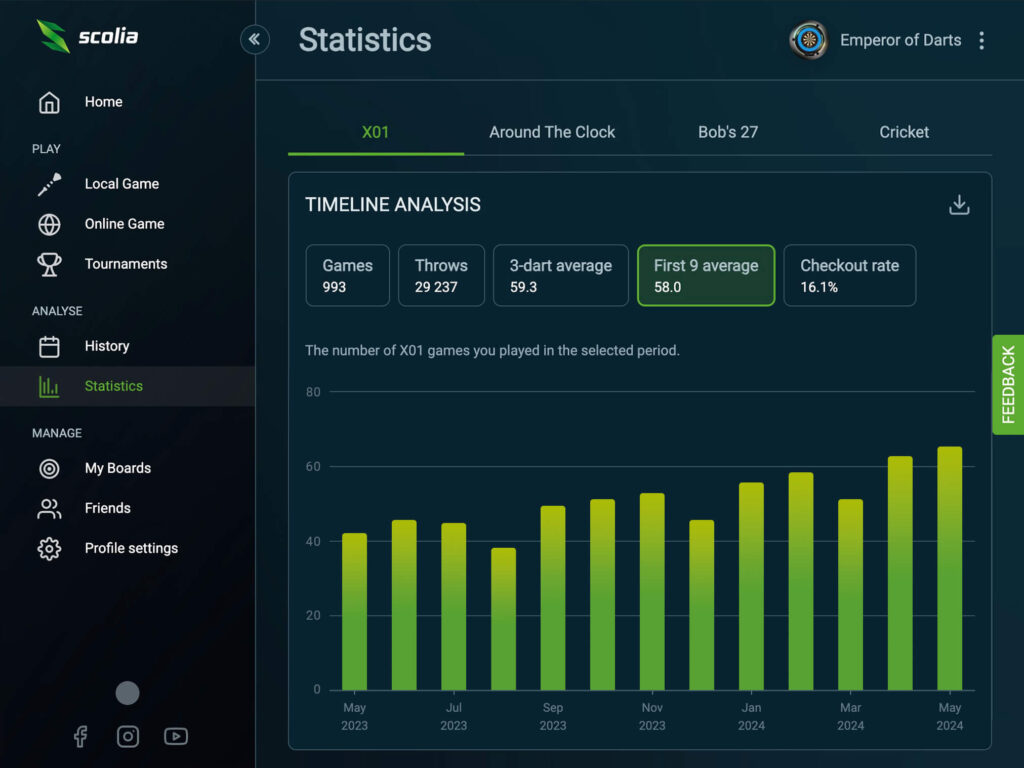
The browser-based Scolia web app supports local and online matches, training games, tournaments, statistics and heatmaps. Setup, board compatibility and connection requirements differ across Scolia models.
Autoscoring is most useful when you want scorekeeping to fade into the background while keeping steel-tip play. If that fits you, see how Scolia automatic scorekeeping works.